Ten questions about ATR 72 aircraft

The Finnair fleet consists of approximately 80 aircraft, twelve of which are ATR 72 aircraft. The ATR 72 has been part of the FInnair fleet for a long time. Finnair’s then subsidiary Karair was the first airline to take the aircraft into service in October 1989, a year after the type's first flight in 1988. Today, Norra, or Nordic Regional Airlines, operates 12 of the newer generation ATR 72 aircraft for Finnair.
Fleet Manager Karoliina Parhiala has worked at Norra for ten years in the Continuing Airworthiness Management Organisation (CAMO). Continuous airworthiness management covers things like preparing and maintaining aircraft maintenance programmes and making sure maintenance is carried out on time. As the expert on the ATR 72, Karoliina answers ten questions.
1. When did Finnair get the first ATR 72 aircraft and how many does Finnair operate today?
“The first ATR 72s appeared on Finnair flights in 1989, operated by Karair. Before that, Finnair had flown the ‘little twos’, the smaller ATR 42, since 1986. After Karair, ATR 72 aircraft have been operated for Finnair by Finncomm Airlines, Flybe Finland and today by Norra. Finnair currently has 12 newer generation ATR 72s, operated exclusively for Finnair by Norra.
The designed lifespan of an ATR aircraft is 70,000 flights or flight hours. Depending on utilisation, that can mean up to 40 years. The newest aircraft in the current ATR fleet, OH-ATP, was built in 2012 and is close to the halfway point of its lifespan."
2. What are the dimensions of the aircraft? How much does it weigh?
“The ATR 72 measures 27.17 metres from the radome to the tip of the tailcone, with a wingspan of 27.05 metres. Ground clearance on an empty aircraft is about 0.6 metres. Empty, it weighs roughly 13 tonnes; fully loaded with passengers and cargo, about 10 tonnes more."
3. What is the seating capacity of the ATR 72? And how many pilots and cabin crew members work on board?
“Our fleet includes two ATR 72 configurations: seven aircraft have 68 passenger seats and five have 70. Both versions share the same cargo hold size. Each ATR flight is operated by two pilots and two cabin crew members.”
4. Where do the ATR aircraft fly? What are the shortest and longest routes?
“ATRs mainly fly to destinations in Finland, the Nordic countries and the Baltic countries. In July 2025, ATR 72 aircraft served 26 destinations across Finland, Norway and nearby areas. The shortest and most frequent route is Helsinki, Tallinn, Helsinki, with a flight time of 30 minutes each way at most. The longest routes are to Norway: Tromsø takes 2 hours 50 minutes, Bergen 2.5 hours.”
5. How high and how fast can the ATR 72 fly? And what is the longest distance it could theoretically fly?
"The ATR 72 has a maximum altitude of 7,620 metres and a cruising speed of 463 kilometres per hour. Tromsø and Bergen are currently the furthest destinations reachable with a full aircraft. With half a load of passengers, the ATR could reach the Mediterranean from Helsinki. Every two years, the ATRs undergo a three-week heavy maintenance in Slovenia, where they fly as ferry flights without passengers. Lighter line maintenance is done at Helsinki Airport.”
6. What special features does the ATR 72 have?
“The ATR 72 is self-sufficient: it has a reverse gear and its own stairs, so it needs almost no ground equipment from the airport. Runway requirements are modest too: 1,500 metres of length is enough for most ATRs, and 30 metres of width.
Short flights on the ATR 72 are fuel-efficient. Fully loaded, the aircraft uses only 2.5 to 3 litres of fuel per 100 passenger kilometres, less than most cars.
On average, a Finnair ATR flies about eight flights a day, and on some days as many as 14. ATRs handle almost 30 percent of Finnair's daily flights. Small as it is, the ATR carries as many passengers per day as a single Airbus A350, thanks to the number of flights it operates.”
7. Does the ATR 72 use any technology that Finnair’s other aircraft don’t have?
“The ATR is an older generation aircraft. Where other aircraft have electronic control surfaces (Fly-by-Wire), the ATR uses mechanical control via wires, so flying the ATR is closer to traditional flying.”
8. What kind of engines does the ATR 72 have?
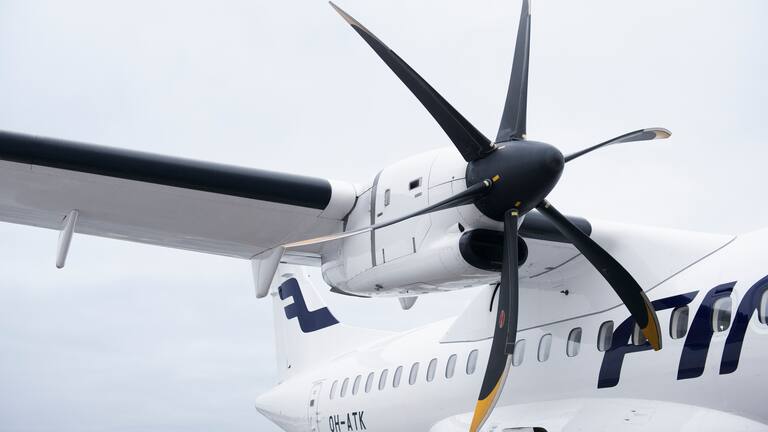
“The ATR 72 has Pratt & Whitney Canada PW100 series engines, specifically the PW127M model. The engines drive six-bladed Hamilton Sundstrand 568F propellers.”

9. What do you think our customers don’t know about this aircraft type?
“The right propeller on the ATR 72 has a propeller brake that stops the propeller while the engine keeps running. That lets pilots generate electricity and keep the air conditioning on while the aircraft is on the ground. The function is called Hotel Mode.”
10. What is your most memorable moment with the ATR 72?
“I led the cabin renovation and painting project in 2019 and 2020. The renovation took place in Tallinn, where new seats were installed and the cabin was redesigned to match the Finnair brand. Some cargo spaces were enlarged, and the aircraft were repainted to match the rest of the Finnair fleet.
The first modified aircraft arrived from Tallinn to Helsinki in the dark of night and was taken straight into the hangar. The project had been kept quiet, with no photos released in advance. The flight arrived later than planned, which meant our own staff were the first to see the aircraft."