Your Finnair Guide: Hidden gems of Tokyo

Sugamo – improve your health the local style
This quaint downtown area is just 20 minutes from Tokyo Station on the JR Yamanote Line. While Tokyo’s famous Harajuku area is known as a gathering place for the young, Sugamo could be playfully described as "Grandmas' Harajuku".

The centrepiece of the town is the Koganji Temple. According to an old legend, the temple’s Jizo statue appeared in a samurai's dream, telling him that his wife's illness would be cured by throwing pictures of Jizo into the river. This proved to work, so since then, locals have believed that praying to Jizo brings them good health. The Jizo statue itself is not shown to the public, but you can buy small paper images of it instead.
There is another healing statue in the temple that you are welcome to visit. It is believed that the Arai-Kannon statue heals your ill body parts when you wash the same part of the statue. Perhaps worth a try?
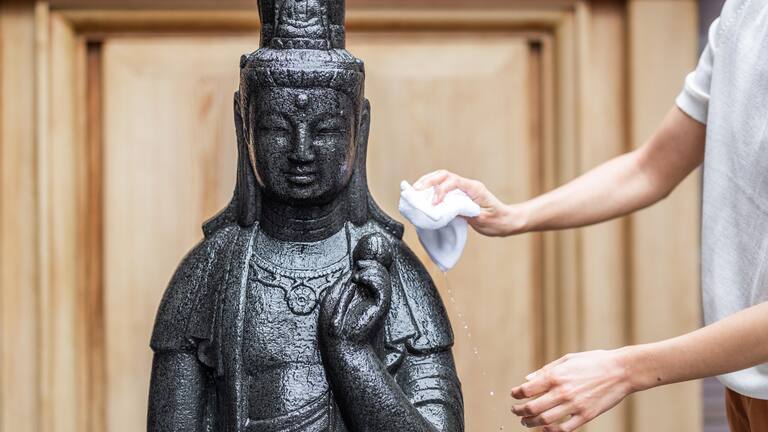
After the temple visit, enjoy shopping and dining on the shopping street in front of the temple. You may notice that many shops sell red underwear, which is considered good for health in traditional East Asian medicine. Thus, people who wish for a long and healthy life buy red underwear. In the area, you’ll also find many shops with traditional Japanese sweets, photogenic snacks, and restaurants in which you can enjoy well-balanced Japanese set menus.

If you walk 10 minutes in the opposite direction of the temple from Sugamo station, you’ll reach Rikugien, a landscape garden completed in 1702. Here you can enjoy seasonal flowers and see gardening techniques unique to Japanese gardens. Rest a while in the teahouse and take in the beautiful scenery with traditional matcha green tea and a sweet bite.

Kappabashi Tool Street – find your favourite kitchen item
If you take a step further from Asakusa and Tokyo Skytree areas, which are known as Tokyo's top tourist attractions, you come to a shopping street called Kappabashi Dougu Street. This special place is a little different from ordinary shopping streets, and customers gather here from all over Japan.

Even though this shopping district is meant mainly for professional chefs, you are welcome to shop here too. You’ll find good-quality souvenirs and gift items here. Let's see why people come all the way to Kappabashi to shop.
Traditional Japanese tableware
Many tourists like to purchase Japanese tableware as a souvenir from Japan. Each region in Japan has its traditional pottery with its own characteristics. In Japanese dining etiquette, you hold the dish in your hand while eating. Compared to Western tableware, Japanese dishes are lighter and more comfortable to hold in your hands.

In recent years, many Japanese tableware items have been designed to suit not only Japanese cuisine but also many other types of food as well. You may find your favourite one right from this shopping district without having to travel all over Japan.
Besides pottery, there are many wooden, glass, and lacquerware items in Kappabashi. As this area is mainly for professionals who need a huge amount of tableware, many of the products are at a reasonable price compared to major department stores.

Kitchen knives made to last for generations
Knives made by Japanese artisans are known for their high quality and preferred by top chefs around the world. Japanese swords are famous for their sharpness, and the same forging techniques are used to make kitchen knives. Master artisans say that it takes a lifetime to master all the techniques required to create a perfect knife. Not only their skills but also good materials, firing and polishing are essential in producing high-quality knives.
A knife made with this kind of care is used for generations. You’ll find many types of knives, but if you only want to buy one knife, choose a santoku knife, which suits fish, meat and vegetables alike. It will soon earn its place in your kitchen.

When wandering around Kappabashi Street, are you able to spot a golden Kappa statue? A kappa is a type of yokai, a creature from Japanese folklore, which looks like a frog with a plate on its head. It’s meant to symbolise prosperous business for the merchants.
Jindaiji temple area – escape from the hectic city life
Located in Chofu in western Tokyo, Jindaiji temple was founded in 733 and is the second oldest temple in Tokyo after Sensoji in Asakusa. The quiet, green area is easy to reach from the city centre, yet the city noise fades quickly and the day passes as if you had stepped back in time.

The street to the temple is lined with quaint restaurants and souvenir shops. It’s fun to get small sweets such as soft-serve ice cream with a Japanese twist and skewered dango-dumplings, and eat them while walking around.
For 20 years, the most eye-catching cafe in the area was the Kitaro Chaya teahouse, with a large yokai looking down at passers-by from its roof. In November 2024 the shop moved to Tenjin-dori shopping street, a four-minute walk from Chofu Station, where it still sells Kitaro sweets and souvenirs. Kitaro is the main character of the yokai manga "GeGeGe no Kitaro" by Shigeru Mizuki (1922–2015), who lived in Chofu for over 50 years. Around Jindaiji and Chofu you’ll still find his characters on bus exteriors and monuments in the shopping streets. Kitaro has been loved in Japan for decades, and meeting his characters is part of the area’s charm.

While in Jindaiji, try the local soba noodles. The area has abundant spring water, and soba made with it has been a local speciality for centuries: around 20 soba restaurants line the approach to the temple. You can eat them with hot soup in winter or cold dipping sauce in summer, and they taste good in any season. If you choose juwari soba, made from 100% buckwheat flour, you also get a gluten-free dish with the full flavour and texture of soba.
After visiting the temple, how about a visit to the Jindai Botanical Gardens on the north side of the temple? Its rose garden has around 5,200 roses of some 400 varieties, which bloom in May and again in autumn.

If you get tired of walking, visit the Yumori no Sato hot spring, a six-minute walk from the temple, before returning to your hotel. While many hot springs are in the mountains, here you can bathe in a natural hot spring without leaving Tokyo. You can get there by bus from Chofu Station or Musashisakai Station. As you bathe naked, there are separate sides for women and men. You don’t need to bring your own towel or shampoo, but tattoos must be covered with a patch before you go in.
Finnair flies directly from Helsinki to Tokyo every day. The flight takes around 13 and a half hours.

Your Finnair Guide series showcases different Finnair destinations through the eyes of finnairians. Join us to discover unique and not-so-obvious areas, places, sights and experiences that are worth a visit, the ones that locals also enjoy.